9 Days Annapurna Base Camp Trek From Pokhara
Annapurna Base Camp
Trip Highlights
Trip Overview
Looking for a moderately challenging but highly rewarding trek in Nepal?- Yes, it’s none other than the Annapurna Base Camp trek itself. It is also known as the Annapurna Sanctuary Trek, as it leads to a sacred basin considered holy by the local people. This walk takes you close to some of the highest mountains in the world. You will trek through forests, small villages, rivers, and high hills to the base of the Annapurna mountain (8,091 metres).
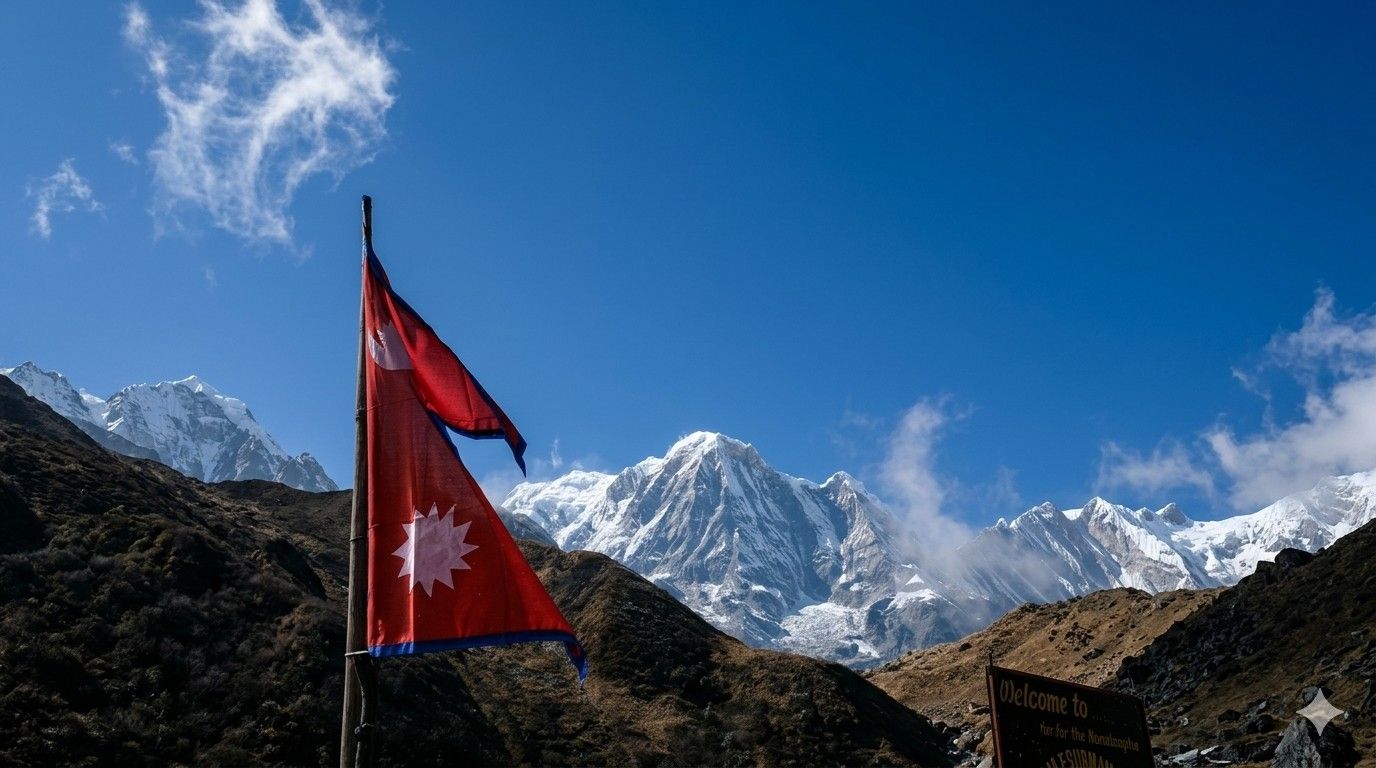
The tour begins and ends in the peaceful city of Pokhara. From there, you will travel through places such as Ghorpani, Tadapani, Chhomrong, Bamboo, and finally Annapurna Base Camp. On your way, you will be greeted by fantastic views of mountains like Machapuchare (Fishtail), Annapurna South, Hiunchuli, and Dhaulagiri.
One of the best parts of the trip is the morning hike to Poon Hill, where you can see a beautiful sunrise in the mountains, a scene you will never forget. You will also pass through settlements of the Gurung and Thakali communities in different villages. These people are friendly and kind. You can learn a lot about their culture, try local food, and enjoy their warm hospitality.
With Fair Trek Nepal, everything is well organized. We take care of your permits, transport, guides, porters, and security. You don't have to worry about anything - just trek and enjoy the mountains. This trek is not just about reaching a certain destination (The Annapurna Base Camp). It's about enjoying nature, learning about the local methods of life, and creating a memory that will be with you forever.
Route observation from Pokhara to Annapurna Base Camp
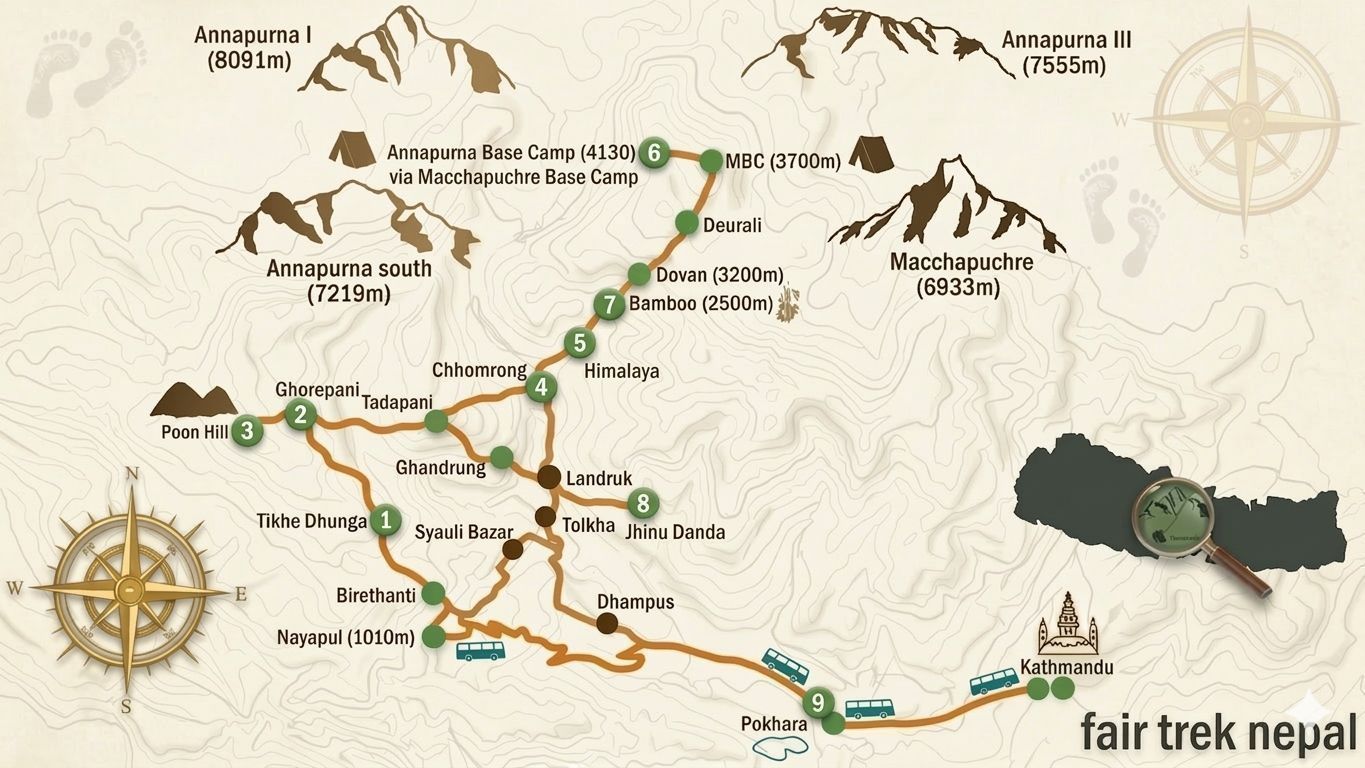
The tour usually starts from Pokhara. From there, a small drive takes you to the trailheads, such as Nayapul or Siwai. The route goes through villages such as Tikhedhunga, Ghorepani, Tadapani, Chhomrong, Bamboo, and Deurali before it reaches Annapurna Base Camp. Returning follows the same way. The total trek takes 7 to 10 days, depending on speed and route options.
Large villages and stops.
Each stop on the route gives something special:
Ghorpani - An important checkpoint in your journey, known for its Rhododendron forest and access to Poon Hill.
Tadapani - A popular place that provides some stunning views of Machapuchhare and Annapurna.
Chhomrong - A beautiful Gurung village with terraced fields that gives you the taste of the rural Himalayas.
Deurali - A place surrounded by rocks and forests. It's the entrance to regions at higher altitudes.
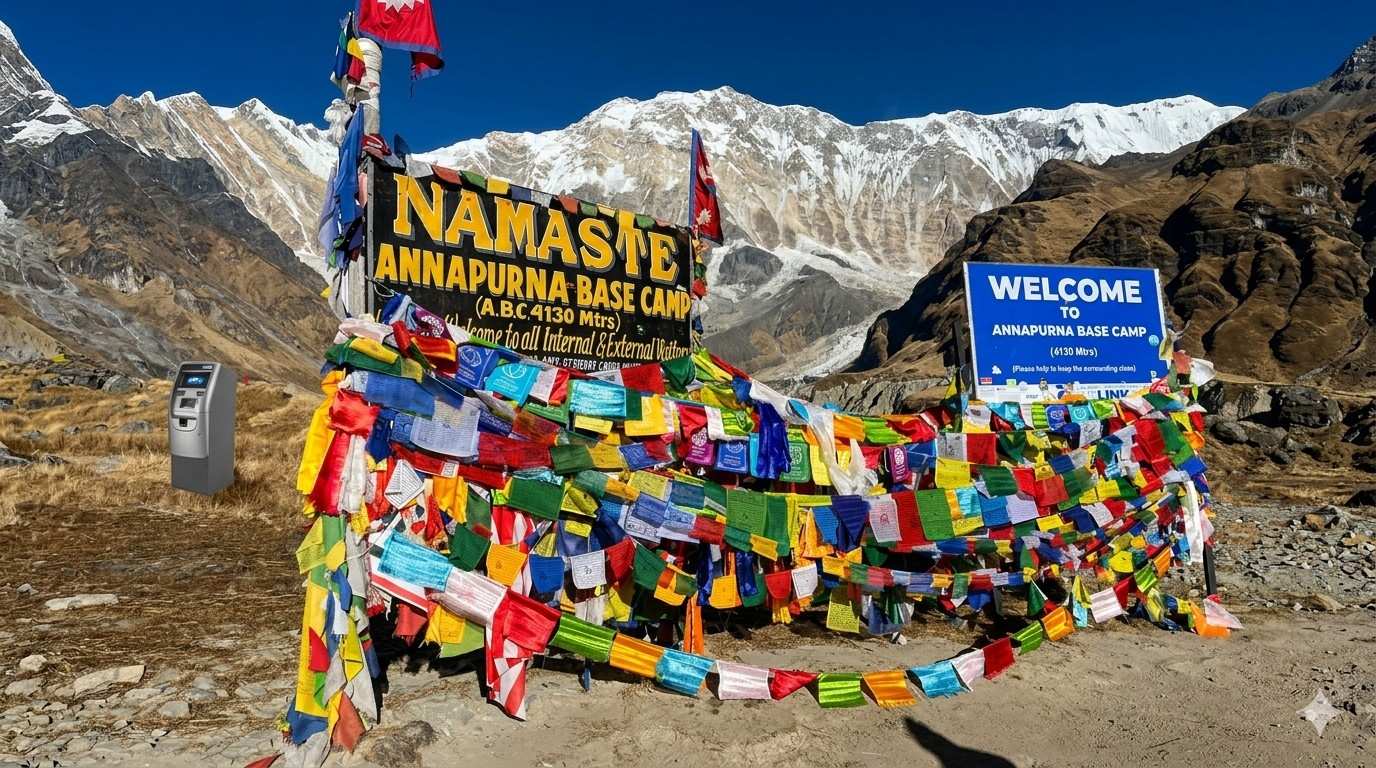
Annapurna Base Camp - The heart of the Himalayas, surrounded by icy giants.
Highlights
- Walk through colorful rhododendron forests in spring, where the bright red flowers cover the hills like a carpet. It's the most beautiful natural garden you'll ever see.
- Cross the exciting suspension bridges over rushing rivers. Feel how you are swayed in illusion as you take each step ahead. The loud water below you will give you an unmatched thrill.
- Watch the famous Machhapuchare mountain up close. Its pointy peak that turns golden at sunset looks like it could cut the sky in two.
- Stay in cozy mountain teahouses at night. Enjoy hot meals while sitting around warm fires. The friendly locals will definitely make you feel at home.
- Wake early for sunrise on the snowy peaks. Watch the mountains change from soft pink to glowing gold.
- Soak in natural hot springs after hiking where the river flows nearby. The warm water relaxes your tired muscles and makes you feel comfortable.
- Stand at base camp surrounded by huge mountains where all around you are some of the world's highest peaks. The thin air makes everything feel extra quiet.
- Eat delicious local food after long hikes. Simple dal bhat also tastes amazing when you're this hungry. Just mark our words, you'll remember these meals forever.
Trek Difficulty and Physical Preparation for Annapurna Base Camp
The Annapurna Base Camp Trek is considered moderate and beginner-friendly. You do not need rock climbing experience or technical skills. However, walking for 5 to 7 hours a day in different areas, including rocky landscapes and forested trails, demands a decent fitness level.
How long and how difficult is each day?
Expectedly, you’ll have to trek for 10 to 15 kilometers on average, which usually takes 5 to 7 hours. The difficulty varies from one day to another. Some days include extreme, ascending, and descending while others may follow relatively mild forest trails. When you reach a higher altitude, the pace must be slowed down, but a steady one is required to make things manageable.
What level of training do you need?
You don't have to be an athlete, but you should be able to hike for a few hours without fatigue. Good cardio fitness and strong legs are important. If you walk regularly, try hikes often, or are physically active, you will probably do well. The success rate is a hundred percent once you are trained and prepared. So the question is, how to train for the ABC trek?
Start exercising at least one month before the trip. Be aware of endurance and foot strength. Practice of:
- Walking/Running 4 to 6 kilometers daily
- Climbing stairs or hills
- Practicing yoga and stretching training
- Carrying a backpack during exercise
- Remember, consistency is more important than intensity.
Mental preparation
Prepare mentally for long trekking days, basic accommodation, and unexpected weather. Some days can be cold or tiring, and the facilities can be basic. Thus, keeping a flexible mentality, staying positive, and focusing on adventure will make the trip more fun.
Annapurna Base Camp Trek is suitable for most people with average fitness and good preparation. With proper physical and mental preparation, you can complete the trip comfortably and safely.
Packing list for Annapurna Base Camp Trek and required equipment
Packing properly means a safe, more comfortable trek. Here's a clear, understandable list of what you must have, what you should bring, and what's good, but optional. This helps you pack smart without overloading your backpack.
What do you need to pack for this 9 Days Annapurna Base Camp Trek from Pokhara?
This is the basics - you can't trek without them.
| Items | The reason for carrying it |
|---|---|
| Trekking boots | Essential for rocky, uneven paths |
| Waterproof jacket & pants | Weather changes fast; rain and wind protection |
| Thermal base layers | Stay warm in cold mountain air |
| Insulated jacket | Keeps you warm in the early mornings and evenings |
| Backpack (30–40L) | To carry daily essentials |
| Sleeping bag (-10°C rating) | Nights get cold, even indoors |
| Water bottle | hydration system |
| Trekking poles | Reduce stress on knees and improve balance |
| Headlamp + extra batteries | For early starts and dim lodges |
Important equipment you should bring
These items improve your comfort and safety on the trek.
| Items | The reason for carrying it |
|---|---|
| Hat & sunglasses | Protection from harsh sun |
| Gloves (light + warm pair) | For cold mornings and high altitudes |
| Quick-dry trekking pants | Avoid discomfort and chafing |
| Breathable trekking shirts | For temperature control |
| Personal first-aid kit | Treat blisters, headaches, or stomach issues |
| Sunscreen & lip balm | Strong UV at altitude |
| Insect repellent | Useful at lower altitudes in spring/autumn |
| Toiletries | Toothbrush, paste, wet wipes, sanitizer |
| Power bank & charging cables | Limited electricity in tea houses |
Optional but helpful Items
Alternatively, but useful, these make your trip even more fun.
| Items | The reason for carrying it |
|---|---|
| Camera or smartphone | Capture epic mountain views |
| Plastic bags | Protect clothes and electronics |
| Snacks | Quick energy on the trail |
| Water purification tablets | When bottled water isn’t available |
| Gaiters | Keep mud and snow out of boots |
| Travel pillow | Makes buses and tea house stays more comfortable |
Smart tips to pack
- Pack light and layered: The weather changes from hot valleys to cold alpine areas. You have to adjust yourself quickly.
- Use compression bags to save space for your warm clothes and sleeping bags.
- Keep your daypack light: Take just what you need for the day; Leave other items in the main bag.
- Double-check the comfort of the footwear before you start, to avoid blisters.
- Mark your equipment or pack with a light tag for easy identification.
- Carry additional money for charging, snacks, and emergency conditions - the ATM is not present on the trek. So, get them when you are in Pokhara.
Best time to trek to the Annapurna Base Camp
Season-wise weather observation
The Annapurna trail undergoes four changes during the four main seasons: Spring, Summer (Monsoon), Autumn, and Winter. Each season has its unique weather conditions that affect your trekking experience.
Spring (March to May)
Spring is one of the best times for Trekking. The weather gets warm, and the blooming rhododendron colors the forests. Day temperatures range from 15 ° C to 25 ° C at lower heights, but are cooler at higher altitudes. The sky is mostly clear, with a beautiful view of the mountains.
Summer / Monsoon (June to August)
The monsoon season brings heavy rain and clouds. The trails become slippery and muddy, and there is a greater risk of landslides and floods. Many trekkers avoid this season, although the landscape is lush and green.
Autumn (September to November)
Autumn is one of the most popular trekking seasons in Nepal, due to stable weather, clear skies, and mild temperatures. The days are warm (at 15 ° C to 20 ° C lower height), however, the nights are still cooler. This season provides some of the best panoramic outlooks of the Himalayas from Annapurna Base Camp.
Winter (December to February)
Winter brings colder temperatures, especially at high altitudes where snowfall is common. The days are short, and some tea houses may be closed early. Even trekking can be harsh, due to humidity and extreme cold. However, this season gives a true sense of solitude even in one of the most popular trekking destinations in Nepal because most avoid the season due to the trekking difficulties. Hence, experienced trekkers wanting solitude can definitely try this out and experience the Himalayas in their purest form.
Which is the best time to go for the ABC trek?
Annapurna Base Camp is best for trekking in the following season:
Spring (March to May) Autumn (September to November)
These months provide the best combination of favorable weather, clear views, and comfortable temperatures. During these seasons, the trails are busy, but are well-maintained.
How does the weather affect your journey?
Visibility: Clear weather lets the trekkers get the luxurious Himalayan views from viewpoints such as Poon Hill and ABC.
Trail status: Trails are drier during the pre-monsoon and post-monsoon seasons. These times are ideal for safe and easy walking.
Safety: Avoid monsoons for safety reasons. There’s always a risk of a landslide and damaged trail this season. In winter, prepare for ice and cold temperatures at higher altitudes.
Understanding the seasons and choosing the right one can make the Annapurna Base Camp Trek safe and more fun. Plan your journey according to your comfort and preferences for cold, crowd, and scenery.
Permits and regulations for the 9 Days Annapurna Base Camp Trek From Pokhara
Starting the Annapurna Base Camp (ABC) Trek is an exciting adventure in itself. And in Fair Trek Nepal, we ensure that all the permits and logistics are handled for you.
So, nothing to worry about your permits. They are our responsibility. This includes:
Annaparna Conservation Area Permit (ACAP)
It is a mandatory permit for all the trekkers entering the Annapurna region, issued by the Tourism Board of Nepal, Kathmandu, or Pokhara. The main purpose is to preserve the natural beauty and biodiversity of the region and maintain the trail throughout the year.
Please note that the TIMS card is no longer required for the Annapurna region. ACAP is sufficient when trekking with a registered guide, which is now a mandatory requirement.
It is important to have legitimate insurance for your safety and security during the trip. Even if we handle the permit, it is recommended to keep a copy of your passport and insurance with you during the trip.
Travel insurance
In Fair Trek Nepal, while we manage the necessary trekking permits, travel insurance is your personal responsibility. We strongly recommend that you get travel insurance that covers medical expenses in emergency conditions, Helicopter evacuations, Trip cancellation, and lost or stolen belongings. This coverage is important for your safety and ensures security for the Annapurna Base Camp Trek. If you faced any trouble or confusion getting them, consult with us as soon as you get to Nepal.
Carry important documents
Although Fair Trek Nepal handles the official permits, you should keep your passport and a copy of your insurance documents with you at all times. These copies are the necessary backups in terms of damage or an emergency on the trail.
Health and Safety Tips for Annapurna Base Camp Trek
Acute Mountain Sickness (AMS) can catch anyone over 2500 meters of altitude, with symptoms such as headaches, dizziness, and nausea. To prevent this, climb slowly, stay hydrated, and take rests whenever necessary. If the symptoms worsen, immediate diagnosis is necessary. For this, we have trained and experienced guides who can identify and handle such situations.
It is necessary to maintain basic hygiene on the trip. Wash your hands frequently, drink clean or boiled water, and eat freshly cooked foods. Avoid raw food and carry an individual first aid kit with essential medications.
Stay hydrated by drinking at least 3 liters of water daily and using electrolyte powder to maintain balance. Choose nutritious foods such as lentils, soup, and fruit to keep you energetic.
In emergencies, Fair Trek Nepal guides are equipped with medical sets and can arrange a helicopter withdrawal if necessary. Always inform your guide about health problems, and always keep the emergency contacts.
Additional Info
Money and expenses at Trek
When doing the Annapurna Base Camp trek, carrying cash is very important because ATMs are limited outside the big cities, and credit and debit cards are rarely accepted in tea houses or stores. Although most of the expenses are covered in our package(from accommodation to three times meals), you should carry enough Nepali rupees to cover your extra expenses like buying local handicrafts, extra snacks, and more.
Language and communication
Nepal's official language is Nepali, which is widely spoken along the Annapurna Trail. Many local people, especially those involved in tourism, speak basic English to help trekkers. Learning simple Nepali phrases like "Namaste" (Hi), "Sanchai Chha?" (How are you?), And "Dhanyabad" (Thank you) will help you communicate and show respect for the culture. When needed, your guide will also help with translation and communication, which will make the experience more engrossing.
Mobile and Internet Connectivity
Mobile phone coverage on the Annapurna Base Camp Trail is surprisingly good in many areas for networks such as Ncell and Nepal Telecom. You can buy a local SIM card in Pokhara or Kathmandu for cheap calls and data. While most tea houses provide Wi-Fi, internet speed can be slow and inconsistent, especially at higher altitudes. It is best to limit your expectations and prepare yourself to disconnect and enjoy nature.
Best Photography Spots
The Annapurna region offers good opportunities for photography. Poon Hill is known for the sunrise views over the top of the Himalayas and is a must-visit spot for photographers. Annapurna Base Camp also gives a dramatic view of Annapurna I, Machapuchare, and other huge mountains.
Cultural Immersion and Festive Traditions in the Annapurna Region
The Annapurna region is home to the Gurung and Tamang communities with rich cultures and traditions. Trekkers pass through villages with stone houses and terraced fields, where locals often share stories and customs. If you go during festivals like Dashain or Tihar, you can see vibrant decorations and dances. Some villages also host small cultural programs. While festivals enrich the experience, they can cause traffic jams, so plan accordingly. Honoring local customs and supporting local businesses can enhance your journey experience.
Female Trekkers: Fair Trek Nepal Safety and Support
Female trekkers are warmly welcomed along the Annapurna Base Camp Trail. We have great concern for your preferences and safety, and we act accordingly. We can even offer experienced female guides when requested timely. Even our men guides are professionals with safety knowledge, respectful behaviours, and prior experience of guiding women trekkers.
Understanding the importance of cultural sensitivity, we can even help girls to get dressed comfortably and respectfully. Our team ensures safe accommodations and 24/7 support to make your trekking experience positive and safe.
Responsible trekking practice
It is everyone's responsibility to protect the natural beauty of Annapurna. Use the reusable water bottles and bags to reduce plastic waste on the trail. Support local economies by living in a family-run tea house, buying handmade crafts, and eating local food. Always follow the ‘Leave no trace’ principle: Avoid garbage, stay on marked trails, and respect wildlife and sacred places. These small steps make you a responsible trekker and help to preserve the environment for future trekkers.
Annapurna's Untold Facts
- Annapurna, means "the goddess of the harvest," is named after a Hindu deity believed to protect the land and its people.
- The peak of Machhapuchare (Fish tail mountain) has never been submitted. It is due to the respect towards the belief that the mountain is home to the Mountain deities, or even lord Shiva.
- The Annapurna I is sometimes called the cursed mountain, due to its high fatality rates.
- Almost 8 out of 10 trekkers at Annapurna Base Camp have strange, vivid dreams. Some say it’s the thin air; others feel the mountain’s spirit calling. These dreams are rarely forgotten.
Detailed Itinerary
A day-by-day breakdown of your adventure. Click each day to expand details.
Altitude: 1,540 meters
Duration: 4–5 hours
Distance: 9 km
9 Days Annapurna Base Camp Trek from Pokhara begins with a beautiful drive from Pokhara to Nayapul. The ride completes in about 1.5 to 2 hours, which takes you through lush green landscapes and beautiful villages like Birethanti and Hile.
After reaching Nayapul, you start walking on a simple trail that goes through attractive villages and green rice fields. You will be following the Modi river, where you have to cross some suspension bridges as well. The trek is not very difficult and requires about 4 to 5 hours to complete until you reach Tikhedhunga. Tikhedhunga is a quiet village surrounded by hills and mountains, and the place where you’ll be staying overnight today.
Altitude: 2,860 meters
Duration: 6–7 hours
Distance: 12 km
Today's Trek is a little difficult in the beginning. You will have to climb more than 3000 stone steps to reach a village named Ulleri. This village rewards you with beautiful mountain scenes. After Ulleri, the path becomes gentle and takes you through thick rhododendron and oak forests. If you go in the spring, the forest will be full of colored flowers.
After trekking for 6 to 7 hours on the forested trail, you’ll reach a popular stop at ABC Trek, known as the Ghorepani. Wonderful scenes of Dhaulagiri and Annapurna await you there.
Altitude: 3,210 meters at Poon Hill, 2,630 meters at Tadapani
Duration: 6–7 hours
Distance: 11 km
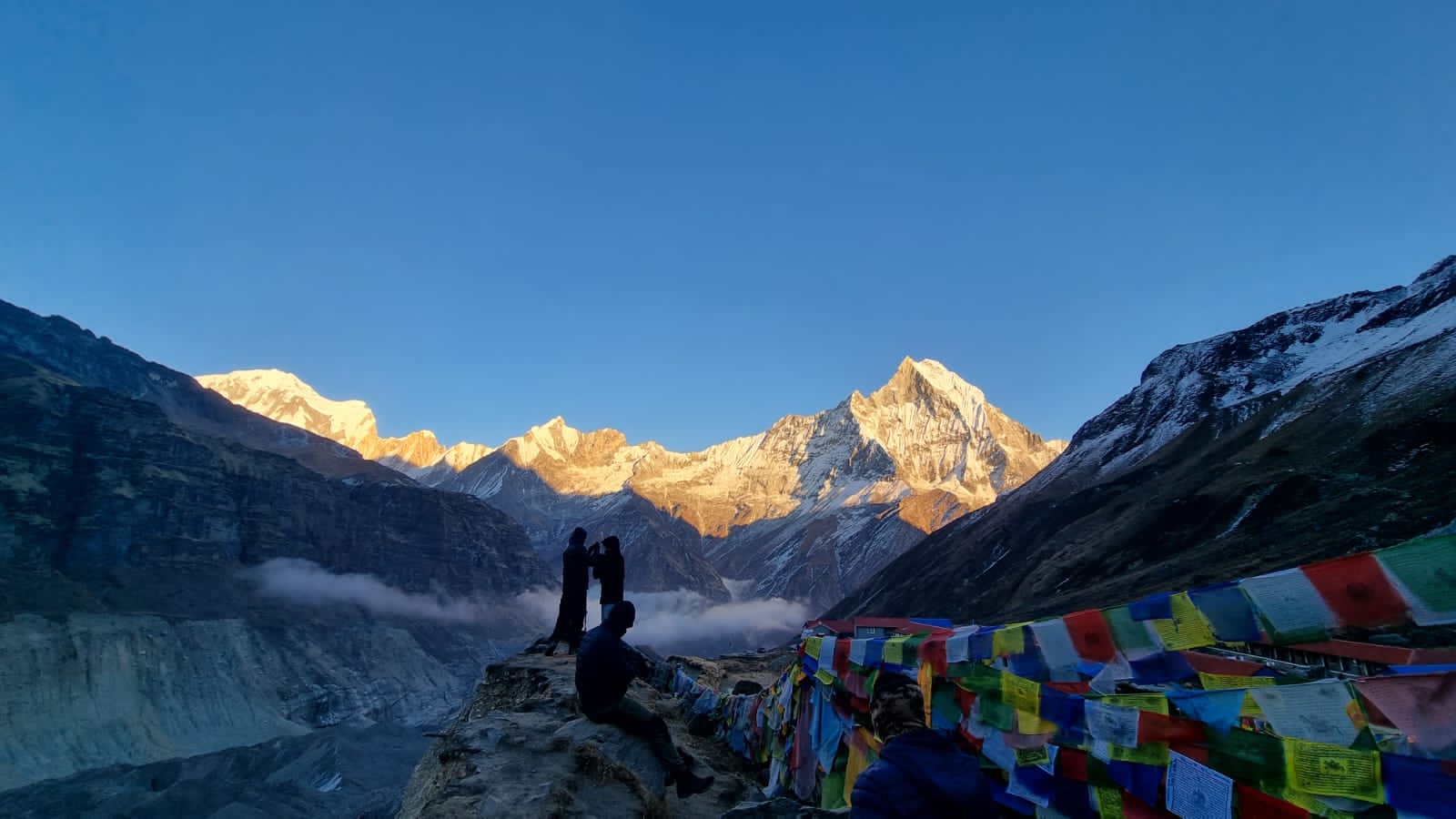
Before the sunrise, you will hike to Poon Hill to witness one of the best sunrises in Nepal. Be right on time, and soak in the mesmerizing view over the Annapurna and Dhaulagiri ranges. After enjoying the views and taking a picture, you will return for breakfast.
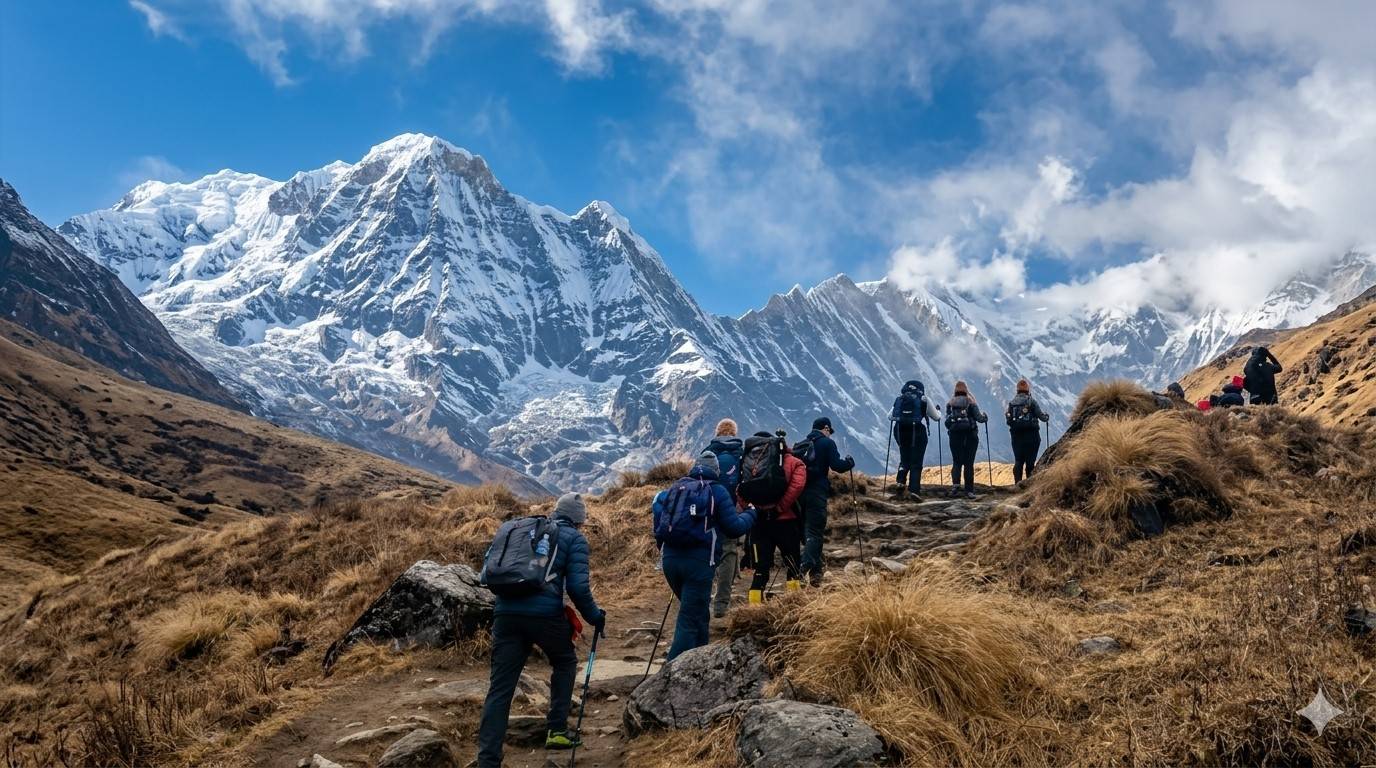
The trip then continues through the forests with several gentle ascents and descents. Walking for about 5-6 hours on the serene and scenic trail, you’ll finally reach Tadapani, a small village surrounded by forest and mountains.
Altitude: 2,170 meters
Duration: 5–6 hours
Distance: 10 km
After breakfast in your homestay, you’ll start walking through a peaceful forest, spotting monkeys and rare birds. The trails today would involve some ascents and descents, passing through many terraced fields and small villages.
After a few hours, you reach a beautiful Gurung Village, Chhomrong, sitting in front of Machapuchare (Fishtail Mountain). The village has good access to tea houses and the internet. It is famous as a significant comfort point on the Annapurna Base Camp Trekking Route.
Altitude: 2,920 meters
Duration: 6–7 hours
Distance: 13 km
Firstly, you’ll be descending from Chhomrong and crossing a suspension bridge over Chhomrong River. Then you’ll climb through dense forests of bamboo and Sinuwa. The more you go, the cooler it becomes. Now the settlements are fewer, and you will feel close to the mountains. After walking around 6 to 7 hours, you reach the Himalayas, where your guides will arrange a simple but comfortable room for the night.
Altitude: 4,130 meters
Duration: 6–7 hours
Distance: 12 km
It is the most exciting day of the trip. You will be passing through a narrow glacial valley and the Hinku Cave. When you climb higher, they become more impressive as you reach the Machhapuchare Base Camp. If this is your first trek in the mountains, you’ll be stunned by the gigantic peaks that surround you.
After a little break in Machhapuchhre Base Camp (MBC), continue your Annapurna Base Camp (ABC) trek. The trail is not very steep, but since you are at a great height, you have to go slowly. When you come to ABC, you are surrounded by huge Himalayas from all sides. The scene is magical, especially during sunset.
Altitude: 2,310 meters
Duration: 6–7 hours
Distance: 14 km
Get up early to see Annapurna and the surrounding mountains and go to see the sunrise. This is a moment you will never forget in life. The feeling of accomplishment when you are witnessing this wonder of nature is unmatched.
After breakfast in ABC, you start backtracking on the same route. Since you are going downhill, it is easier for your lungs but might be a little hard on your knees. So, descend with concern. Slowly, you’ll pass the Deurali and Dovan and finally reach your today’s place for overnight stay, the bamboo.
Altitude: 1,780 meters
Duration: 4–5 hours
Distance: 9 km
From Bamboo, move towards the Kuldighar and then to the Chhomrong river. To reach the Chhomrong village, you again need to climb the steep way. Then, finally, a short descent takes you to the Jhinu Danda, a peaceful village known for its natural hot springs.
After checking in your accommodation, you have to walk for about 20 minutes to relax in warm water next to the river. This is the right way to let your tired muscles relax.
Altitude: 820 meters
Duration: 3–4 hour drive
Today is the last day of trekking. After breakfast, go to the village of Siwai or Samrung, which takes about 2 to 3 hours. From Siwai, a private jeep or a local vehicle will take you back to Pokhara. The ride takes about 3 to 4 hours. When you come to Pokhara, you can check in and relax at the hotel.
After completing the 9 Days Annapurna Base Camp Trek from Pokhara, today is your rest day in Pokhara. You can relax on the lakeside, enjoy local food, or enjoy activities such as boating at Fewa Lake, paragliding, visiting the world peace pagoda, or even getting a massage. This is a great day to relax and recover.
Included & Excluded
- teahouse, lodge accommodation
- Experienced English-speaking trekking guide
- All required trekking permits & TIMS card
- Airport/hotel transfers (pick-up & drop-off)
- All ground transportation during the trek
- First aid kit & emergency evacuation support
- Government taxes & service charges
- International flights to/from Kathmandu
- Nepal travel visa fees
- Personal travel & medical insurance
- Personal gear & clothing
- Tips for guides and porters
- Personal snacks, drinks & bottled water
- Hot showers & battery/device charging fees
- Any costs due to delays or itinerary changes
Trek Route Map
Click to enlarge the map
Frequently Asked Questions
Traveller Reviews
"the experince was really awesome"